Service as vocation
The Glass Bead GameService as vocation is the ideal that a person’s gifts and life should be placed in the service of a worthy master. In Joseph Knecht’s account, the ideal drives his long, unsettled choice of the Glass Bead Game, but it also exposes a disagreement about what service requires: whether the servant may seek the highest available calling, or must remain loyal to the authority already accepted. The Rainmaker story offers a stark counterpoint, presenting service as responsibility to a community that finally demands the Rainmaker’s life.
Knecht’s search for a master
Knecht explains his ideal through the legend of St. Christopher, a strong and courageous man who wished to serve rather than rule. Christopher’s service depended on finding the greatest master; when he heard of a mightier one, he offered that master his services. Knecht says he has always been drawn to this figure and sees a resemblance between them. The legend gives his vocation a searching, upward direction: service is not merely submission to a post, but a continuing attempt to recognize what deserves a person’s fullest powers.
Knecht’s own search began during his student years, which he describes as the one period when he had command over himself. For years he remained mistrustful of the Glass Bead Game and resisted giving himself to it. He had already recognized the Game as the most precious and characteristic fruit of Castalia, and knew its extraordinary attraction. Yet he also sensed that it could take total possession of anyone who yielded to its magic. An instinct for simplicity, wholeness, and soundness made him wary of the spirit of the Waldzell Glass Bead Game elite: its cultivated specialism and virtuosity seemed isolated from humanity and the whole of life, and had risen into what he regarded as haughty solitude.
That resistance did not settle the matter. Knecht says he doubted and probed for years before deciding in favor of the Game. He chose it because he felt within himself the urge to seek supreme fulfillment and serve only the greatest master. His decision thus arose neither from untroubled obedience nor from ignorance of the Game’s dangers. It followed a period in which attraction and suspicion remained in tension, and in which commitment meant accepting the claims of the very institution he had feared might narrow his life.
The dispute over loyalty
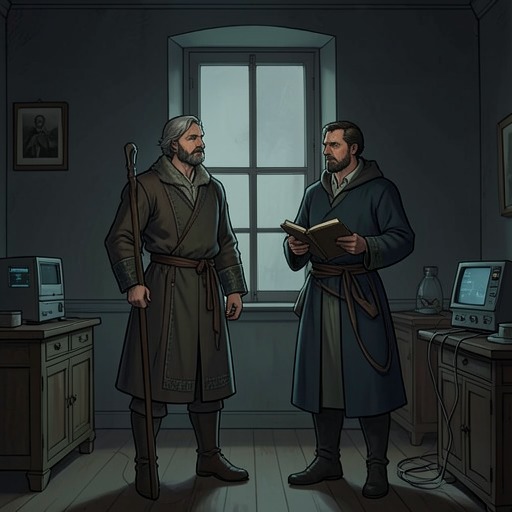
Master Alexander interprets Knecht’s independence differently. He distinguishes great ability from a balanced fit within an established system: a person may possess exceptional gifts yet expend strength in eccentric movements that unsettle himself and those around him. In Alexander’s view, Knecht’s distinctive conduct comes from an excessive dependence on his own person, a tendency that had been concealed but was now emerging more forcefully.
Alexander also rejects St. Christopher as a model for a servant within a hierarchy. A servant, he argues, must abide by the master to whom he has sworn loyalty, in good fortune and bad, rather than reserve the right to change allegiance upon discovering a more magnificent master. To seek and rank masters for oneself, Alexander contends, makes the servant his own master’s judge. The disagreement is therefore not over whether service matters, but over who has the authority to determine its object: the individual conscience that continues to search, or the hierarchy whose authority has already been accepted.
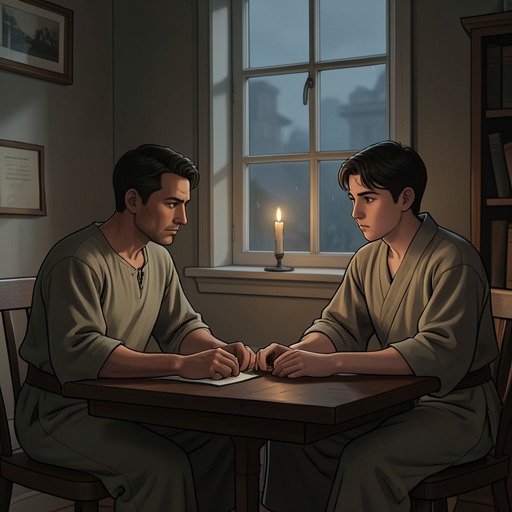
Knecht listens respectfully and acknowledges that he expected Alexander to hold this view, but continues his account. He recalls that, after becoming Magister Ludi, he was for a time sure he served the highest master. His friend Designori had described the earlier Knecht as an arrogant, conceited, blasé elitist and virtuoso of the Game. That recollection places his ideal beside its possible distortion: devotion to a demanding calling can look like service to something greater, while also producing pride in one’s own mastery.
The Game’s collective vocation
The history of the Glass Bead Game gives Knecht’s choice a wider institutional setting. The Game developed from a virtuoso arrangement of concepts into a practice that required contemplation. Rapid displays of memory by players with little beyond mnemonic skill were increasingly prohibited; in their place, players were required to meditate silently on each symbol’s content, origin, and meaning. This change was understood as a necessary turn toward a religious spirit, keeping the Game’s signs from becoming empty forms.
The Game also moved beyond private exercise into public ceremony. Though people remained free to play privately, its public form became the practice most commonly associated with it. A few superior Masters led these ceremonies under the authority of their country’s Master of the Game; invited guests and wider audiences followed, while some sessions continued for days or weeks. Players and guests observed demanding rules, including limits on sleep, and submitted to a life of ascetic absorption. These practices made service to the Game more than individual expertise: the players’ attention and discipline helped make the event a shared undertaking.
The spring solemn Game in Castalia preserves that collective purpose on a more local scale. Once annual Games lasting weeks drew dignitaries and representatives from across the world, but that great age had passed. The spring festival, with a solemn Game usually lasting ten days to two weeks, nevertheless remained a central event for Castalia. It gathered sometimes divergent intellectual tendencies into symbolic harmony, checked the disciplines’ competing ambitions, and recalled the unity embracing their variety. For believers it carried the force of consecration; for unbelievers it could serve as a substitute for religion. In either case, its shared attention presented service not simply as personal advancement, but as participation in a whole larger than any one discipline.
The Rainmaker as communal servant
The Rainmaker tale makes the responsibilities of service concrete through Knecht’s apprenticeship to Turu. The old Rainmaker passes on specialized knowledge through practical instruction rather than a system of concepts or written methods. Its core includes knowledge of the moon’s phases and effects, and a tradition in which the moon receives the souls of the dead and sends them into new births. This vocation is a form of inherited custodianship: what Turu teaches Knecht must be tested through the senses and carried forward as a body of communal experience.
Turu’s office is important but does not set him apart from ordinary village life at every moment. He works the common land, tends a small garden, gathers food and firewood, and hunts and fishes. His particular standing comes from the services required of him: advising the community about weather and growth, and determining the proper spring sowing dates through inherited rules and personal experience. Even this authority has limits. The ritual act that opens the seeding season, scattering the first handful of grain and seeds on communal land, belongs to the tribal mother or her oldest female relative, because it is considered too sacred for a man to perform.
When drought or prolonged cold threatens famine, the Rainmaker’s work becomes more urgent. Turu leads sacrifices, exorcisms, and processions, but tradition holds that when every means has failed, the community may sacrifice the Rainmaker himself. Knecht later warns his son that the falling stars and worsening conditions may cost him his life. If he is sacrificed, he tells Turu to take up the office immediately, have his body burned, and scatter the ashes over the fields; he also warns him to protect the community’s seed grain through the hungry winter, in the expectation that the next year will improve and the villagers will welcome a new Rainmaker.
That prospective instruction becomes an immediate decision when the crops fail and the village turns against Knecht. Maro incites the people, threats are directed at the Rainmaker, and the processions and sacrifices Knecht leads bring no relief. Knowing that Maro has already pressed the tribal mother to have him sacrificed, Knecht takes the last step himself. He dresses Turu in ceremonial robes, presents him as successor, and offers his own life. At the appointed clearing he tells the assembled villagers that he has done his work as well as he could, that his efforts have failed, and that his sacrifice may placate the demons. He names his son as the new Rainmaker and asks the community to obey him afterward.
In Knecht’s own account, vocation remains a continuing search for the highest service, and Alexander’s response reveals the cost of making that search an individual judgment. In the Rainmaker story, service is bound to succession and collective need: Turu must inherit both the craft and its responsibilities, while Knecht accepts the fate attached to the office. The two accounts do not erase their difference. One tests the freedom to choose a master; the other shows a vocation whose authority is inseparable from communal tradition, and whose final service is presented as a sacrifice for the people it is meant to sustain.